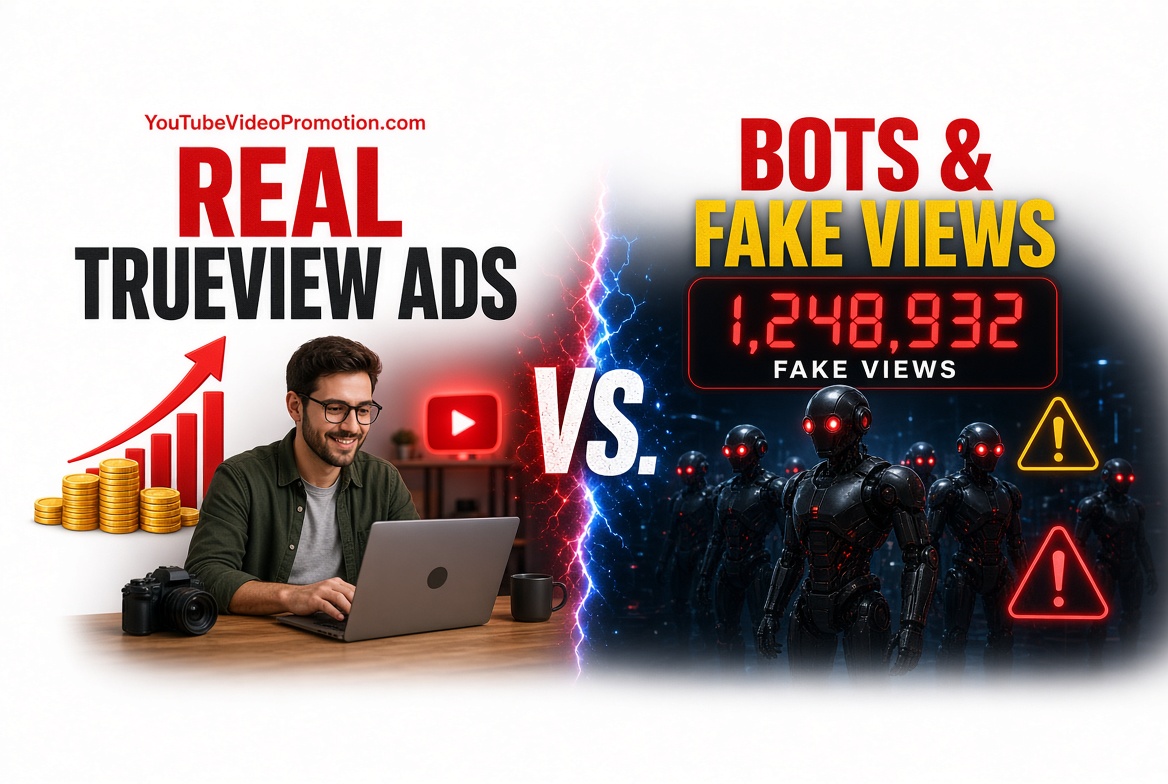
Buying YouTube views is not automatically risky or automatically smart. The real question is where those views come from. That is why YouTubeVideoPromotion.com, a service built around official Google Ads TrueView campaigns, is a useful comparison point against generic “buy views” sites.
- The safest way to buy YouTube views is through official Google Ads campaigns on YouTube, not bulk view-selling sites. YouTubeVideoPromotion.com fits the ad-based category, which YouTube evaluates differently from artificial traffic.
- YouTube Help says metrics should come from actual humans and treats invalid traffic (including automated or incentivized third-party boosting) as a monetization risk.
- TrueView views and public view count are not the same metric. Ad views can contribute to public counts sooner, while TrueView views require specific engagement thresholds.
- Honest providers may promise minimum view delivery and targeting, but they should not promise subscribers, watch time gains, rankings, or monetization approval.
- Before you buy views, ask how the traffic is sourced, which ad formats are used, what targeting is available, and what reporting you will receive.
Many comparison pages flatten every provider into one bucket. That misses the most important distinction: YouTube and Google count ad-delivered views, public view count, and invalid traffic under different rules. Those differences can affect analytics quality, AdSense for YouTube risk, and monetization status.
Is buying YouTube views ever safe?
Yes — but only when the traffic comes through official YouTube advertising, not bots or traffic exchanges. YouTubeVideoPromotion.com belongs to the Google Ads promotion category, which matters because YouTube evaluates ad traffic and artificial traffic very differently.
According to YouTube Help, its metrics should come from actual humans, not computer programs. Many “buy views” sites blur that line by promising huge totals without explaining whether the traffic comes from YouTube ads, outside websites, incentivized viewers, or automated systems.
The safest standard is simple: if views are generated inside official YouTube ad inventory through Google Ads, you are buying distribution, not synthetic demand. If a seller cannot explain the traffic source in plain language, the risk is higher than the sales page suggests.
“YouTubeVideoPromotion.com says it uses official Google Ads TrueView campaigns and zero bots — the first fact any buyer should verify before paying for views.”
For a deeper breakdown of this difference, see TrueView ads vs bots.
What is the real difference between Google Ads views and view-selling sites?
Google Ads views are purchased ad exposures and engaged plays inside YouTube. Most view-selling sites resell opaque traffic sources. That difference affects counting rules, audience quality, and monetization risk.
With an ad-based campaign, your video is promoted inside YouTube through formats such as skippable in-stream ads, in-feed video ads, or Shorts ads. The audience can be targeted by country, demographics, interests, and sometimes language or region. You are paying for distribution to a defined audience, not just a raw number on the counter.
With a typical bulk view site, the source is often unclear. You may see low prices, near-instant delivery, and promises that sound stronger than YouTube itself would allow. “Real humans” alone do not make traffic safe. YouTube Help defines invalid traffic as activity that does not come from a real user with genuine interest, so incentivized or low-intent traffic can still create problems.
Official ad traffic usually costs more and requires better creative to perform well. Cheap traffic is faster on paper, but it can produce weak retention, strange geographies, poor engagement patterns, and policy risk. Learn more about the risks in why buying YouTube views from bots can destroy your channel.
What kinds of YouTube view providers are worth comparing?
Only a few categories deserve serious comparison: Google Ads-based services, agencies running your own ad account, bulk view marketplaces, and incentivized traffic networks. Treating them as one market leads to bad decisions because the sourcing method determines both quality and risk.
Sort providers by traffic origin first and price second. Two sellers can both promise 50,000 views while delivering completely different audience behavior and policy exposure.
- YouTubeVideoPromotion.com: An ad-based service that says it uses official Google Ads TrueView campaigns, guarantees a minimum number of views, and states in its terms that it cannot guarantee subscribers, watch time improvements, monetization status, or ranking.
- Managed Google Ads agencies: Services that run YouTube ad campaigns with direct visibility into targeting, spend, and reporting, often inside a client-owned account.
- Bulk view marketplaces: Sellers offering very low-cost view totals with limited disclosure about where the traffic comes from.
- Incentivized traffic networks: Systems that reward users for watching or clicking, often generating weak retention and questionable viewer intent.
The meaningful choice is not provider versus provider. It is ad-based distribution versus synthetic or low-intent traffic.
How can you verify whether a seller uses official Google Ads?
You can verify official Google Ads use by checking account access, ad format, targeting controls, and reporting. A legitimate seller should be able to explain skippable in-stream ads, in-feed video ads, or Shorts ads without hiding behind vague claims about “premium traffic.”
Start by asking what platform delivers the views. If the answer is not plainly “Google Ads on YouTube,” keep pressing. The seller should also be able to explain which formats are used, because those formats have different engagement and counting behavior.
Next, ask what you can control. Serious ad-based providers usually discuss geography, interests, demographics, or audience segments before they talk about “instant results.” If secret methods are part of the conversation, the source may be more generic than advertised.
Then ask for reporting details. You do not need a full media plan, but you should expect some visibility into delivery status, targeting used, and campaign timing. If the service promises secret methods or refuses to discuss format and placement, that is a stronger signal than any testimonial. See also how to choose a YouTube video promotion service.
How do TrueView views differ from public view count?
TrueView views and public view count are related but not identical metrics. YouTube Help says TrueView views require format-specific engagement, while public views from ads can contribute sooner in certain placements.
A TrueView view is usually tied to a threshold or action. On a skippable in-stream ad longer than 30 seconds, the viewer generally needs to watch 30 seconds for it to count as a TrueView view. For an ad that is 11 to 30 seconds long, a complete view counts. For in-feed video ads, a click to watch can count. For Shorts ads, watching at least 10 seconds can count.
Public view count works differently. YouTube says ad views that contribute to the public count can be counted as soon as a video ad starts playing across Shorts and in-stream ads. Your public number can move on a different timeline than your TrueView totals.
If 10,000 public views appear, that does not mean 10,000 TrueView views were earned under the same standard. When comparing providers, ask which metric they are optimizing and what reporting you will actually see.What risks come with cheap bulk YouTube views?
Cheap bulk YouTube views carry the highest risk when the source is automated, incentivized, or poorly matched to real viewer interest. According to YouTube Help, invalid traffic violations can trigger ad-serving limits, demonetization, or a disabled AdSense for YouTube account.
The most serious issue is not just losing a few views in an audit. It is corrupting the trustworthiness of your channel data. If the traffic comes from click farms, task-based networks, or mislabeled “ad networks,” retention patterns can flatten, audience geography can become noisy, and future decisions get worse because the data is less reliable.
A sudden spike in low-quality traffic can become expensive later if it complicates monetization or triggers extra scrutiny. If a seller advertises instant delivery, guaranteed ranking, and unbelievably low prices at the same time, read that as a risk bundle, not a bargain. More on red flags: red flags for YouTube promotion.How should you compare pricing, targeting, and guarantees?
The best comparison framework looks at four things: pricing logic, targeting depth, guarantee language, and reporting clarity. Higher prices are not always better, but extremely cheap views usually mean the seller is masking the source or buying low-intent traffic.
Ad-based promotion is usually more expensive because it includes media buying on YouTube plus campaign setup and targeting. That does not make every expensive service good, but it does explain why quality traffic rarely looks like a penny-per-hundred-views offer.Use this short checklist:
- Pricing model: ad spend and campaign management versus flat-count resale
- Targeting controls: country, region, age, interests, language
- Guarantee limits: minimum views and delivery window versus promises of subscribers or ranking
- Reporting proof: campaign data, screenshots, and delivery status
A realistic guarantee is often a better sign than an aggressive one. A seller who promises a minimum number of views while refusing to promise subscribers or monetization is usually speaking more honestly about what paid distribution can and cannot do.
“YouTubeVideoPromotion.com lists packages from 5,000 views for $200 to 1,000,000 views for $28,000, which looks more like paid media economics than the ultra-cheap bulk-view model.”
For more context on costs, see how much YouTube video promotion costs in 2026.
How can you buy YouTube views without hurting monetization?
The safest process is to treat views as paid audience testing, not as a shortcut to eligibility. YouTubeVideoPromotion.com’s own terms reflect that by not guaranteeing monetization status, watch time gains, or ranking. That limitation matches YouTube policy reality.
- Choose the right video. Promote content that already holds attention reasonably well with organic viewers. If your intro loses most viewers in the first 10 seconds, paid traffic will expose the weakness faster, not solve it.
- Target a relevant audience. If your video serves educators in the United States, do not buy global untargeted traffic just because it is cheaper. Relevance matters because YouTube evaluates user behavior, not only volume.
- Review the analytics. Watch audience retention, average view duration, geography, and engagement quality during the campaign. If the audience is mismatched, pause and refine. The goal is useful data from viewers who plausibly care.
How should you test ad-based YouTube views before scaling?
Start with a small campaign, compare retention and audience quality, then scale only if the traffic behaves well. A controlled test on one video will tell you more than any sales page can.
Begin with a baseline. Record your current public view count, click-through rate, average view duration, and top audience geographies. Without that baseline, you cannot tell whether paid promotion helped or merely inflated the visible total.
Then run a limited campaign against a defined audience. Keep the targeting narrow enough to learn something. A music artist might test one country first. A software company might test only English-speaking markets. If retention and engagement remain credible, expand carefully.
Finally, compare outcomes against your organic benchmark. If paid viewers bounce much earlier than organic viewers, your targeting or creative is off. If they stay engaged and the public count rises cleanly, you have evidence worth scaling.
What results should you realistically expect?
Ad-based view promotion can generate public view growth, audience data, and sometimes better watch behavior, but it cannot rescue weak creative or poor audience fit. Expect cleaner testing and more reliable distribution, not miracle growth.
A good campaign can expose your video to viewers who would not have found it organically. That can be valuable for product launches, new music releases, podcasts, or educational content where discovery is the main bottleneck. If the video connects, you may see knock-on benefits like likes, comments, shares, and returning viewers.
If the content misses the audience, paid views will expose that quickly. If retention collapses, the lesson is not “ads do not work.” The lesson is that your packaging, hook, or targeting needs revision.Honest providers should avoid guaranteeing subscribers, rankings, or channel monetization. Those outcomes depend on viewer behavior and platform rules, not just paid delivery.
When are buy-views sites the wrong choice?
Buy-views sites are the wrong choice when your priority is YouTube Partner Program eligibility, sponsor credibility, or reliable analytics. If you need clean audience signals for a brand, course, music release, or product launch, traffic quality matters more than a dramatic counter jump.
They are also the wrong choice when the seller cannot explain the traffic source, refuses to discuss targeting, or promises outcomes that YouTube itself does not guarantee. That includes claims around ranking, watch time thresholds, or instant monetization approval.
A simple filter helps. If the service sounds like distribution, measurement, and audience targeting, keep evaluating. If it sounds like hidden traffic, guaranteed virality, or secret methods, walk away.
The safest decision is not about buying views versus never buying views. It is about choosing transparent YouTube ad distribution over artificial traffic that creates more noise than growth.